


Investment Policy Statement
Content
Mission Statement
Purpose of Investment Policy Statement
Roles and Responsibilities
3.1 Board of Directors
3.2 Investment Committee
Investment Objectives
4.1 Return on Investments
4.2 Risk Tolerance
Investment Management Guidelines
5.1 Asset Mix
5.2 Cash Flow & Liquidity Requirements
5.3 Investment Products & Portfolios
5.4 Risk Management
5.5 Tax Consequences
5.6 Delegation of Voting Rights
Approval of Eligible Investment Products
Compliance
Conflict of Interest
1. Mission Statement
Benefaction Foundation is a charitable Public Foundation that supports, rewards and inspires philanthropic investments in Canada. Our mission is to encourage philanthropy by helping Canadians maximize charitable giving while minimizing tax burdens.
Benefaction enables individuals, financial advisors and institutions to make a positive impact through planned giving by establishing Donor-Advised Funds with donation monies earmarked for a charity of their choice.
Benefaction will target raising funds through agreements with financial service providers across Canada, enabling them to retain assets under management while fulfilling their client’s philanthropic needs.
2. Purpose of Investment Policy Statement
This investment policy statement provides a set of written guidelines for the management of the Foundation’s investments. The investment policy statement will be reviewed at least annually to ensure that it continues to reflect the Foundation’s requirements.
3. Roles and Responsibilities
3.1 Board of Directors
The Board of Directors of Benefaction has ultimate authority over and responsibility for the Foundation’s investments. In order to ensure that the investments meet the required objectives, the Board will:
Appoint an Investment Committee: Receive the Committee’s recommendations with respect to the
Investment Policy Statement and the approval of eligible investment products.
3.2 Investment Committee
The Investment Committee will:
Maintain an understanding of legal and regulatory requirements and constraints applicable to the
Foundation’s investments on an annual basis, or more frequently if appropriate, review the Investment Policy Statement.
Approve eligible investment products that meet the return objectives and risk tolerance criteria.
Review the investment strategy for the long-term assets held by the Foundation.
4. Investment Objectives
4.1 Return on Investments
The Foundation’s objective is to generate a total investment return that to the greatest extent possible protects the purchasing power of the capital component and the required disbursement level and recovers the cost of managing and administering the funds.
The return objective is to exceed CPI net of management fees and expenses on average annualized. It is understood that this rate of return may not be achieved in each and every year.
The Foundation’s return objectives are ranked as follows:
Preservation of capital
Generation of ‘income’ to meet disbursement requirements
Generation of growth in the capital value of the investments in order to protect their value in real (inflation-adjusted) terms
4.2 Risk Tolerance
Investments should be structured and managed to provide for the generation of the return objective while minimizing the level of risk. Risk will be measured in terms of the standard deviation of investment returns and the downside risk (or risk of loss) of the investment.
Investments are required to maintain an appropriate level of diversification in order to reduce overall risk. In most cases, this will include diversification at the asset class level, geographic level, sector level and security level. Please refer to Risk Management below for specific investment constraints.
5. Investment Management Guidelines
Investment products and Portfolios used within the Foundation should be designed to meet both the return objective and risk tolerance. The goals of the Portfolio are to earn a rate of return that exceeds inflation, while protecting the capital from permanent declines in value. Short term declines in the value of the capital will be expected in line with the usual fluctuations of public investment markets.
5.1 Asset Mix
In order to meet the return objectives, products and Portfolios should have a minimum equity exposure of 40% to allow for inflation protection and capital growth. For preservation of capital to be maintained, products and Portfolios should have minimum cash plus fixed income exposure of 20%.
Asset allocation rules allow for granting policy projections for a particular Gift Fund to override the maximum weight of Fixed Income and Cash.
Any asset class or investment vehicle not specifically permitted by this Policy is prohibited. The Portfolio should be invested according to the following guidelines:
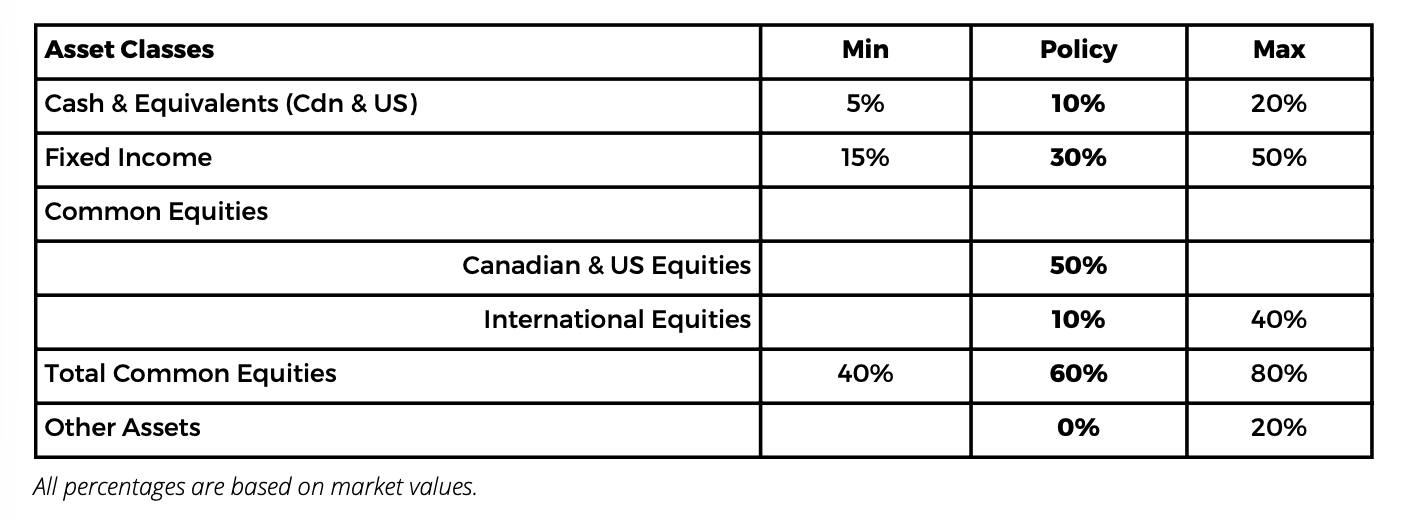
From time to time the Investment Committee may determine it is in the best interests of the Foundation to make exceptions to the Investment Policy. The circumstances surrounding a particular gift or Fund may warrant certain allowances to be made. For example, asset allocations may be approved that vary from policy parameters or options may be permitted within an overall strategy of capital protection.A plan to revert to the Policy with a predetermined strategy and timeline must be in place prior to accepting the gift and allowing the exception.
5.2 Cash Flow & Liquidity Requirements
The Portfolio will be required to disburse a minimum percentage of the value of the Portfolio based on the average endowed Portfolios over the previous two years, subject to current Revenue Canada Agency rules for disbursement. In addition, there are advisor and charitable administration fees to cover. Accordingly, at least 5% of the current value of the Portfolio should be kept in cash or cash equivalents.
5.3 Investment Products & Portfolios
Individual investment products and Portfolios will be assessed on their ability to meet both the return and risk objectives. Products falling outside of the above recommended asset mix will be considered if they demonstrate an equivalent risk-controlled strategy with the ability to meet return objectives. The Portfolio may invest directly in any or all of the following products provided it meets the below asset allocation parameters. These assets may be securities of Canadian or non-Canadian public corporations.
ELIGIBLE SECURITIES
Cash & Short-Term Investments
Cash or money market securities issued by Governments, Corporations or other entities
Guaranteed Investment Certificates, Term Deposits or similar financial instruments of insurance companies, trust companies, banks or other issuers
Commercial Paper, BAs, Money Market Mutual Funds
Fixed Income
Listed Canadian or U.S. Issued Federal, Provincial, Municipal & Corporate Bonds or Notes
Debentures, Mortgage Securities, Canada and U.S. listed Fixed Income Exchange Traded Funds
(ETFs), Fixed Income Closed-End Funds, Floating Notes
Fixed Income Mutual Funds, High-Yield Bond ETFs
Equities
Publicly traded common stocks, preferred securities, convertible and participation preferred securities, Exchange traded funds (ETFs) or other common share equivalent
REITs, royalty trust units, business trust units or index participation units
Mutual funds and pooled funds
Convertible bonds/debentures
Other Assets
With prior approval, Benefaction might also include Alternative or Non-Traditional Assets as eligible securities
5.4 Risk Management
Overall rules for the portfolio:
Single issuer exposure not to exceed 5% of NAV (at market);
No single industry should comprise more than 25% of the equity component with exception made
for financial services to maximum of 45%;
Individual bonds should be investment grade Canadian or U.S. issued bonds;
Preferred shares rated P3 or above may be treated as fixed income
Convertible preferreds and convertible debentures are treated as equity;
Leverage may not be used in the Portfolio;
Derivatives (options or futures) may be allowed where held in a mutual fund or pooled fund for the purpose of hedging currency back to Canadian dollars, or equity replication, in which case the fund policy takes precedence, or downside capital protection
Equities are limited to Exchange traded North American listed equity securities;
International equities are allowable in ADR form only unless held within a mutual fund or pooled fund.
5.5 Tax Consequences
The Portfolio is part of Benefaction Foundation, a registered charity in Canada, and therefore not subject to taxes. Notwithstanding the Portfolio's tax status, it is permissible for the Portfolio to invest in tax advantaged investments if they are seen to be advantageous to the Portfolio in the context of this Policy.
A word of caution: Certain investment products that own U.S. and/or foreign holdings are subject to withholding tax. Even though they are owned by a registered charity, they may not qualify for the 0% withholding tax rate. To ensure best practices and disclosure, Benefaction wish to make donors, and
advisors who are selecting investments for its funds, aware of this industry issue. See our Withholding Tax PDF to learn more.
5.6 Delegation of Voting Rights
The custodian is delegated the responsibility of exercising all voting rights acquired through the Foundation's investments. The custodian will exercise acquired voting rights with the intent of fulfilling the investment objectives and policies of the Plan. Should the custodian receive specific written voting instructions from the Trustees, the custodian shall execute such instructions as given.
6. Approval of Eligible Investment Products
All investment products will be approved by the Investment Committee and presented to the Board of Directors. The Investment Committee will review individual investment products to ensure that they meet risk and return objectives.
Specifically, the Committee will review the:
Investment performance history
Standard deviation of returns
Investment product objectives and guidelines
Managers of the investment products
The Investment Committee will also be responsible for the annual review of the recommended investment products to ensure that they continue to be eligible for investment. If an investment product changes significantly or undergoes an event making it ineligible for investment, the Investment Committee will act to remove it from the program.
7. Compliance
The portfolio must be monitored on an annual basis to ensure compliance with the IPS. Each account held by Benefaction Foundation will be checked quarterly so as to identify any holdings which are contrary to policy rules. If an account is found offside either by disqualified investment or asset allocation, the advisor will receive notice from Benefaction to rectify the situation within a reasonable time frame (by the next quarterly review). If by that time the Portfolio is still in breach, then Benefaction will provide trade instructions to reallocate the investments to be online with policy. Any exceptions to the IPS will be evaluated on a case by case basis by the Investment Committee and once granted will be reviewed within six months. Examples of an exception might be a large grant coming due or the market liquidity of a donated holding to be sold.
Benefaction Foundation may authorize an Agent to exercise any of the trustee’s functions relating to investment of trust property.All Agents acting on behalf of Benefaction Foundation as Investment Consultant must exercise the care, skill, diligence and judgment that a prudent investor would exercise in making investments. The Foundation requires each advisor to provide a quarterly report on the gift funds they manage. Benefaction will monitor non-Canadian dollar exposure on aggregate on at least an annual basis to ensure that it is maintained at level with which the Investment Committee is comfortable.
8. Conflict of Interest
No fiduciary will knowingly permit his or her interest to conflict with his or her duties or powers relating to the investment or management of the Foundation’s assets. Any actual or perceived conflict of interest must be reported to the Board. Such disclosure will be made when the affected individual first becomes, or ought to have become, aware of the conflict or potential conflict. If a conflict does exist the Board will take all appropriate measures to remedy the situation. Every disclosure of a conflict of interest will be recorded in the minutes of the relevant meeting.